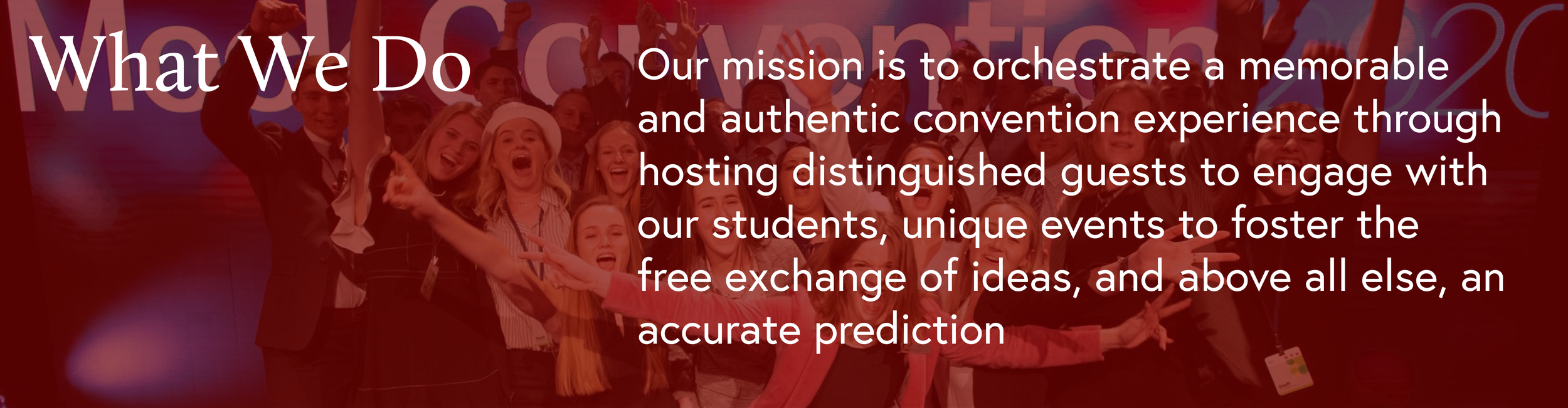
Looking down at the cheering crowds after completing his keynote address, Harry S Truman announced, “This is a real convention, and I ought to known because I’ve been looking at them since 1912…” Perhaps more than any other statement, Truman’s words reflect the public opinion that surrounds Washington and Lee University’s Mock Convention—a quadrennial tradition in which student delegates attempt to predict the presidential nominee of the political party current out the of the White House.
Washington and Lee's Mock Convention has been billed as the nation’s most accurate mock convention since its inception in 1908, but cannot claim to be the oldest such exercise; Oberlin College has one that dates back to pre-Civil War days. Nevertheless, for consistent accuracy—and eye-filling opulence—the Mock Convention simply has no peer. With 18 correct predictions in 23 attempts, the convention has been described by Time as the “biggest and boomingest” of all amateur gatherings. Newsweek, not to be outdone, promptly dubbed it, “the most realistic” student conclave. It has been applauded on the floor of the U.S. Senate as an “outstanding practical experiment in politics.” And as media interest grows steadily in anticipation of an upcoming convention, W&L has received coverage ranging from the Washington Post to live gavel-to-gavel broadcasts on C-SPAN.
The Mock Convention’s success story goes all the way back to the very first meeting in 1908. William Jennings Bryan’s visit to Lexington that spring aroused such an interest that the students decided to hold a replica of the upcoming Democratic convention. Bryan, of course, was a perennial elder-statesman and the proponent of the Silver Standard—as well as a frontrunner for the 1908 convention. In fact, as the W&L convention drew near, only Governor John A. Johnson of Minnesota possessed a sufficient force on the convention floor to rival the Bryan tide.
“The young gentlemen entered into the meeting with the zest of seasoned politicians plus the enthusiasm of collegians,” the Lexington Gazette reported on May 6, 1908. Indeed, by the time the convention concluded, tempers had flared to such a point that several fights had broken out on the convention floor. Despite the commotion, the Mock Convention of 1908 ended with the students’ first correct prediction of a presidential nominee, as Bryan was selected at the actual Democratic National Convention that following summer in Denver.
With the exception of the “brawl of 1908,” frivolity and volatility have rarely been a problem at the convention. One of those rare cases did, however, occur in 1936, when Arthur Vandenburg’s nomination depended on the Pennsylvania vote. The delegation remained deadlocked for some time, until the nomination was “finally decided in his favor by an errant delegate brought in from the tennis courts.”
In contrast, recent Mock Conventions have followed a pattern of near flawless research that began with the 1952 convention. That year, delegate to the convention, including the California state chairman, David Constine, diligently perform remarkable amounts of research. Constine had established a correspondence with then California Governor Earl Warren, whose name was expected to be placed in the nomination as a “favorite son” candidate.
After three W&L ballots the record showed Ohio Senator Robert A. Taft in the lead with General Dwight D. Eisenhower a close second and Warren a poor third. After receiving a report from Constine, Warren immediately wired W&L’s California chairman to free his delegates. Accordingly, California fell in line with the Eisenhower forces ensuring another correct prediction for the Mock Convention.
The following convention in 1956 also resulted in a successful candidate selection, but the victory was overshadowed that year by tragedy which focused all eyes on Lexington.
The guest of honor that year was Senator and former Vice President Alben Barkley of Kentucky. Barkley delivered a rousing keynote speech exhibiting his genuine love for politics and political conventions. In 90 degree heat, he told students he had not intended to go to the real Democratic convention that summer. However, after participating in the W&L event, he had changed his mind, felling “like an old firehorse when he hears the bell.” In his excitement, he accidentally knocked over a microphone. Thinking quickly, he enthusiastically told the audience, “That’s nothing to what’ll happen to the Republicans in November!” Explaining why he had settled for becoming Kentucky’s junior Senator after occupying the second highest job in the land, he said: “I would rather be a servant in the land of the Lord than to sit in the seats of the mighty” (Click Here to Hear Barkley's Final Words). As the crowd roared its approval, Barkley stepped back from the podium and collapsed. Within minutes he was pronounced dead of a heart attack. Only Barkley’s widow could make the student delegates resume their task; “You have unfinished business,” she told convention officials. A week later the convention reconvened, correctly predicting that Adlai Stevenson would once again be the Democratic nominee.
Eisenhower and Stevenson are just two in a series of correct choices made by W&L students in recent years. In fact, since 1948 the convention has only erred once—an admirable ninety-two prediction rate. The only misstep occurred in 1972 when the delegates selected Edward Kennedy rather than George McGovern as the Democratic candidate. Other years have seen more favorable conclusions, including Kennedy in 1960, Goldwater in 1964, Nixon in 1968, Carter in 1976, Reagan in 1980, Mondale in 1984, Dukakis in 1988, Clinton in 1992, Dole in 1996, and Bush in 2000.
When asked for the reason for this series of perfect forecasts, the W&L students insist upon one word alone—research. Acknowledging that no college campus can be regarded fairly as a cross-section of the voting public, the students depend totally on “grassroots” research carried out in all fifty states. Indeed, even personal political preferences are put aside in preparation for an accurate convention.
Despite its serious purpose and political efficacy, the convention is not without festivity. The convention boasts a Spring Kickoff celebration the spring prior to the Mock Convention, with past speakers including Jesse Jackson, Jack Kemp, and Lamar Alexander. Likewise, W&L hosts a Presidential Gala the preceding fall and energizes the city of Lexington with a grand parade the week of Convention, both symbolizing the youthful enthusiasm for this exception event.
Even visiting guests are not immune to a little revelry during the course of the weekend. Two tales endure of future presidents attending the convention. In 1972 Jimmy Carter, then an obscure Governor of Georgia, arrived at W&L to deliver that year’s keynote address. Carter was accompanied by his ever-present press secretary Jody Powell. However, Powell missed his boss’ speech altogether. He gave in, as the story goes, to a temptation offered by several W&L students and alumni, and joined them to play pinball and drink beer at Central Lunch on Main Street, instead of attending Carter’s speech.
In 1988, before his famous appearance on MTV, President Clinton thrilled students by playing the saxophone at an off-campus party in the country. He, too, would use the Mock Convention as a stepping stone to the presidency. These accounts depict the students’ enthusiasm and excitement for this famous event. However, in the areas crucial to the convention’s serious political purpose--from balloting and credentials to facilities planning and media relations--student delegates follow a strategy of research and preparation exemplified by the famed Mock Convention of 1924. That year, W&L put its faith in John W. Davis, a man who wasn’t even a declared candidate and who would shock all the experts when the dust finally cleared. Davis would eventually lose the election to Calvin Coolidge, thereby robbing W&L the privilege of claiming a presidential alumnus. Nonetheless, the dramatic nature of his nomination won the Mock Convention a place in the headlines where it still remains, 75 years later.
At the conclusion of the 1996 convention, the Washington Post declared Washington and Lee’s Mock Convention “one of the nation’s oldest and most prestigious mock conventions.” Today, the balloting may be faster and more advanced and the primaries occurring earlier and earlier, yet an overwhelming excitement still floods the W&L campus as the student delegates play their role in the national presidential election process.